Overtones inside musical instruments: propagation, timbre and resonance
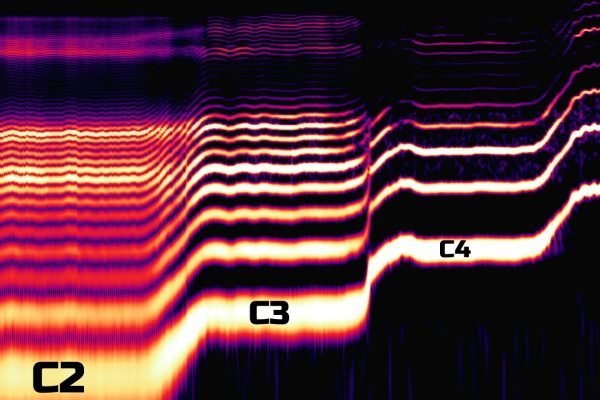
When a musical instrument produces a note, it rarely emits a single frequency. The sound contains a main frequency, called the fundamental, along with other higher-pitched frequencies called harmonics, which propagate uniformly.
The combination of the fundamental frequency and harmonics largely determines the timbre—that is, the instrument’s sonic character. This is why a violin, a guitar, and a flute can play the same note but sound completely different: the pitch may be the same, but the distribution of the harmonic frequencies within each instrument varies, along with any background noise.
An instrument with a strong presence of high-pitched harmonics can sound bright and piercing. An instrument with weaker or more subdued high-pitched harmonics, on the other hand, may sound softer, warmer, or darker.
What are harmonics?
Harmonics are sound components whose frequency, in an ideal situation, is an integer multiple of the fundamental frequency. If the fundamental is 100 Hz, for example, the harmonics may be around 200, 300, 400 Hz, and so on.
The fundamental tone primarily contributes to our perception of a note’s pitch, while the harmonics influence its timbre. Our ears do not necessarily perceive them as separate sounds; instead, they integrate them into a single auditory experience, allowing us to recognize the character of a guitar, a piano, a trumpet, or a voice.
In reality, instruments do not produce a perfectly even series of frequencies. The stiffness of the strings, the material, the shape of the instrument, energy losses, and the way the sound is produced can shift or attenuate certain frequencies. These small deviations often contribute to the richness and naturalness of the timbre.
It is also useful to distinguish between harmonics and partials. Harmonics are partials related to the fundamental by whole-number ratios; partials, on the other hand, include all the frequency components of sound, even those that do not perfectly adhere to this ratio.
How is sound produced?
Sound is a vibration that is transmitted through a medium—usually air—in the form of pressure variations. When a string is plucked, when a bow strokes a string, when a membrane is struck, or when a musician blows into an instrument, a part of the system begins to vibrate.
The vibration sets the surrounding air in motion. This creates a sound wave that travels away from the source and reaches the ear.
The propagation of harmonics does not occur as a series of completely separate sounds traveling through the air. What travels through the air is a single, complex sound wave composed of various frequency components. We can analyze these components separately, but when listening, they are perceived as a single sound event.
The result depends primarily on:
– the way the instrument is excited;
– the vibration modes of the source;
– the resonances of the instrument’s body;
– the material and shape of the instrument;
– the environment in which the sound propagates.
Overtones in String Instruments
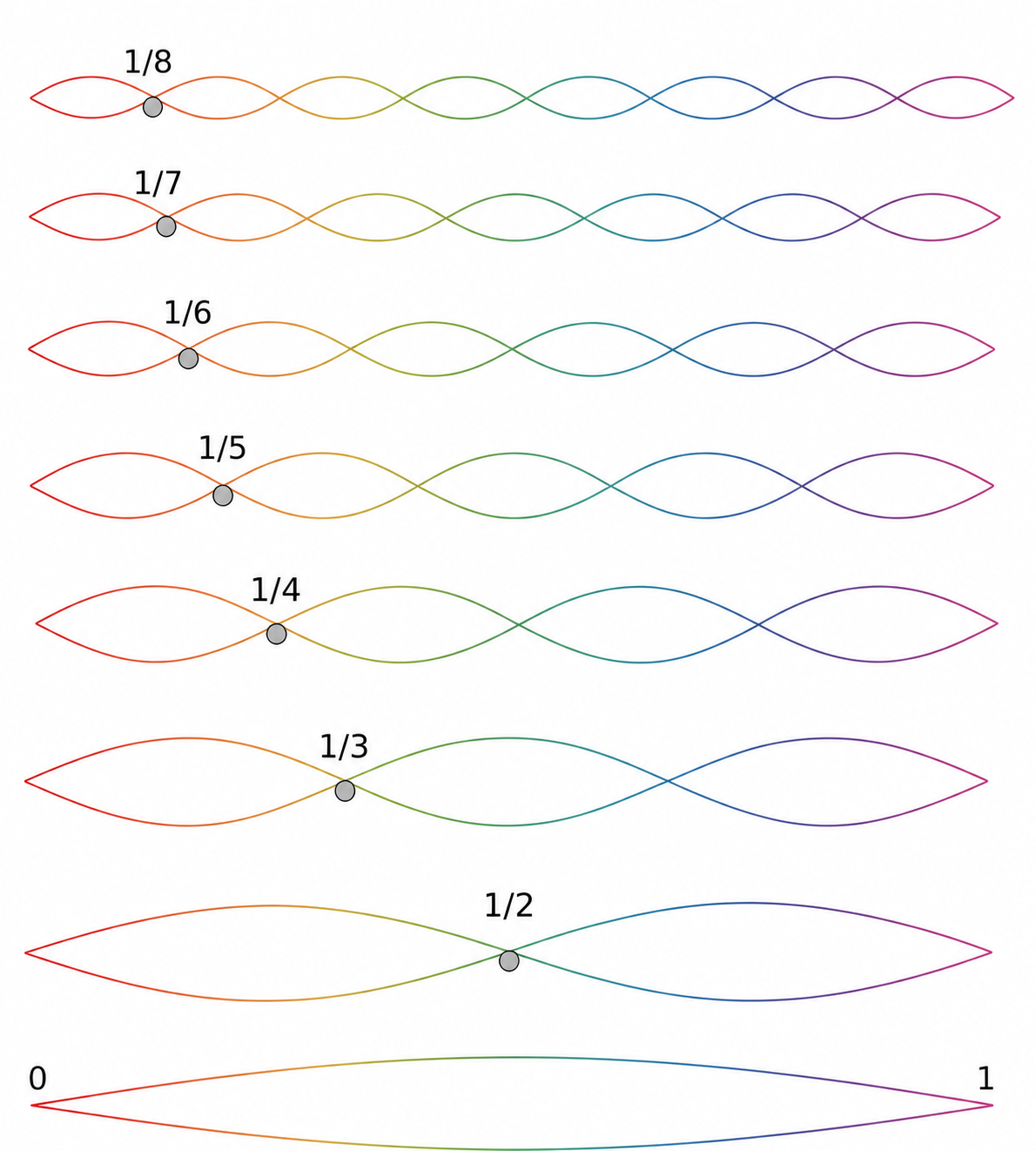
In string instruments, such as the guitar, violin, and piano, sound production begins with the vibration of the string. A string fixed at both ends cannot vibrate in just any way: it can only assume certain stable configurations, called modes of vibration.
In the fundamental mode, the string vibrates in its broadest form, moving almost as a single unit. In the higher modes, however, the string splits into two, three, four, or more vibrating segments. These configurations produce higher frequencies, often related to the harmonic series.
Different modes of vibration can exist simultaneously. Together, they produce a complex sound: the fundamental provides the basis for the perceived pitch, while the higher harmonics help define the timbre.
The Point of Excitation
The point at which the string is plucked or bowed also affects the harmonic content. A string plucked toward the center tends to produce a softer sound, because certain fundamental modes are more strongly emphasized, while several high-pitched harmonics are attenuated.
When plucking near the bridge, however, the sound tends to become brighter and sharper. The point of excitation, in fact, selects certain modes of vibration and inhibits others. This is why a guitarist can alter the timbre even without changing notes, simply by moving the right hand.
The Violin and Other Bowed Instruments
On the violin and other bowed instruments, the bow keeps the string vibrating through a continuous alternation of contact and gliding. Unlike pizzicato, this is not just an initial impulse: the performer supplies energy to the string for the entire duration of the sound.
Bow pressure, speed, point of contact, and angle alter the ratio between the fundamental and the harmonics. A bow position closer to the bridge can produce a more intense and brilliant sound, while a point of contact closer to the fingerboard generally tends to produce a sweeter sound.
Overtones in Wind Instruments
In wind instruments, the primary vibrating element is not a string, but a column of air. The musician’s breath is transformed into vibrations by a mouthpiece, a reed, a mouthpiece tip, or a rim.
Standing waves form inside the tube. The shape of the instrument, its length, diameter, the presence of holes, and whether it has an open or closed end determine which frequencies are emphasized.
Flute and Clarinet
In the flute, the airflow passes through the mouthpiece and interacts with the edge of the bore. The tube selects certain resonance frequencies, and the musician modifies the acoustic length by opening or closing the holes.
The clarinet, on the other hand, uses a single reed and has a different acoustic structure. Put simply, its tube behaves more like a tube closed at one end, while the flute is more like an open tube. This difference affects the distribution of harmonics and helps explain why the two instruments have such different timbres, even when playing the same note.
Trumpet and Other Brass Instruments
In brass instruments, such as the trumpet, French horn, and trombone, the musician causes the lips to vibrate against the mouthpiece. The lips function as a vibrating element, while the internal air column selects frequencies compatible with the instrument’s shape and length.
The bell alters the way sound energy is transmitted outward. The conical or cylindrical shape of the tube also influences the harmonic spectrum, projection, and timbre.
The role of the soundbox
An isolated string produces a relatively faint sound because it displaces very little air. To make the sound more audible, the string’s energy is transferred to the body of the instrument.
In the guitar, this task is performed primarily by the soundboard and the body. In the violin, the soundboard, back, ribs, soundpost, and bridge are involved. In the piano, the vibration of the strings is transmitted to the soundboard through the bridges.
The soundbox does not simply amplify all frequencies equally. It has its own resonances, which reinforce some components and attenuate others. The result is a change in the harmonic spectrum and, consequently, in the timbre.
The material is equally important. Wood, metal, brass, steel, nylon, and cane have different elastic properties and damping capabilities. The instrument’s overall structure therefore determines which frequencies are effectively transmitted and which decay more rapidly.
Helmholtz Resonance and Harmonics
Helmholtz resonance describes the acoustic behavior of an air cavity connected to the outside through an opening or a constriction. The air contained within the opening behaves like a small mass that oscillates back and forth, while the air enclosed in the cavity compresses and expands like a spring.
A simple example is a bottle. When you blow across the rim, the air in the neck is set in motion and interacts with the air inside the bottle. The system has its own resonance frequency, which is perceived as a sound.
Helmholtz resonance does not necessarily generate new frequencies out of thin air. Rather, it selects and amplifies the sound components that are close to its natural frequency. The harmonics are part of the signal produced by the source; the resonant cavity, on the other hand, acts as a filter that can amplify some of them and attenuate others.
A larger cavity generally tends to favor lower frequencies, while a wider opening tends to favor higher frequencies. The length and shape of the opening also influence the system’s behavior.
Helmholtz Resonance in Musical Instruments
The ocarina is one of the clearest musical examples of a Helmholtz resonator. Its body is a generally spherical cavity equipped with holes. Opening or closing the holes alters the acoustic behavior of the cavity and changes the pitch of the sound.
The modern ocarina is associated with Budrio, in Emilia-Romagna, where it was developed by Giuseppe Donati in the 19th century. The Chinese xun, certain gemshorns, instruments made from gourds, and other globular wind instruments also exhibit characteristics attributable to this type of resonance.
In stringed instruments, the soundhole openings contribute to the instrument’s acoustic response. The internal cavity and the openings can produce air resonances that interact with the vibrations of the strings and the body. These resonances help to reinforce certain frequencies and define the instrument’s tonal character.
In the flute, on the other hand, the primary phenomenon is the resonance of the air column along the tube. The mouthpiece and certain holes, however, can introduce local resonances similar, in some respects, to Helmholtz resonances. It is therefore important not to equate every resonance in a wind instrument with a Helmholtz resonance: often, multiple acoustic mechanisms are at work simultaneously.
Overtones and Percussion Instruments
Percussion instruments exhibit a wide variety of behaviors. In an ideal string or a simple air column, the higher frequencies can follow the harmonic series fairly closely. In a membrane, a cymbal, or a metal plate, however, the modes of vibration can produce frequencies that are not organized as integer multiples of the fundamental.
This is why some percussion instruments have a well-defined pitch, such as the vibraphone or certain tuned bells, while others produce a more complex, noisy, or metallic sound. In these cases, it is more accurate to speak of spectral components or partials, because not all frequencies are harmonics in the strict sense.
A drum, for example, can have many modes of vibration at the same time. The shape of the drumhead, its tension, the material it’s made of, and the drum shell all affect the relationship between these components and determine the character of the sound.
How harmonics propagate through the environment
When sound leaves the instrument, all of its components propagate through the air as part of the same complex sound wave. However, the different frequencies do not behave exactly the same way.
High frequencies are generally more directional and can be absorbed more easily by curtains, carpets, people, and porous materials. Low frequencies, on the other hand, tend to spread more widely throughout a space and can pass through certain obstacles more easily.
For this reason, a sound rich in high-frequency harmonics can lose its brilliance when heard from a distance. Furthermore, the listener’s position, the shape of the room, and the presence of reflective surfaces can alter the balance among the various components.
A room furnished with curtains and rugs tends to absorb some of the higher harmonics, making the sound warmer or duller. An empty room, with hard, reflective walls, can instead accentuate certain frequencies and make the sound brighter, harsher, or more reverberant.
Overtones and the Human Voice
The human voice also contains a fundamental frequency and numerous overtones. The vocal cords produce a periodic vibration, while the vocal tract—comprising the larynx, pharynx, mouth, and nasal cavities—acts as an acoustic filter.
By changing the shape of the vocal tract, the speaker or singer alters which harmonics are amplified. The frequencies amplified in this way are called formants and allow us to distinguish one vowel from another.
The voice does not change solely because the vocal cords change. It also changes because of changes in:
– the shape of the tongue;
– the opening of the mouth;
– the position of the jaw;
– the shape of the lips;
– the volume of the pharynx and oral cavities;
– the degree of nasal cavity involvement.
Formants are not harmonics produced directly by the vocal cords. They are resonance frequencies of the vocal tract that amplify certain harmonics already present in the laryngeal signal.
Human whistling and the Helmholtz model
The most obvious example of behavior similar to that of a Helmholtz resonator in the voice is the human whistle. When a person whistles, the mouth forms a resonant cavity bounded at the back by the tongue and at the front by the opening of the lips.
La cavità orale funziona in modo simile alla camera di un risonatore di Helmholtz, mentre l’apertura delle labbra svolge un ruolo analogo al collo di una bottiglia. Il flusso d’aria attraverso l’apertura mette in oscillazione l’aria della cavità e favorisce una frequenza specifica.
By changing the position of the tongue, the shape of the lips, and the volume of the oral cavity, you can alter the frequency that the system favors. In general, a larger internal cavity tends to favor lower frequencies, while a smaller cavity tends to favor higher frequencies.
In whistling, therefore, the oral cavity does not produce a complete set of harmonics as a vibrating string would. Rather, it selects and sustains a specific frequency through air resonance. The sound may contain multiple spectral components, but the dominant one is the component that most closely matches the frequency favored by the cavity.
Overtone Singing and Resonance
The relationship between harmonics and resonance becomes particularly interesting in overtone singing (also known as throat singing). In these techniques, the vocal cords produce a continuous low-pitched note—often perceived as a drone—along with its higher harmonics.
Harmonics are normally perceived as part of the voice’s timbre. In overtone singing, however, the singer modifies the shape of the vocal tract with great precision to select a specific harmonic and make it much more intense than the others.
The tongue creates constrictions and cavities of varying sizes, while the lips regulate the front opening of the mouth. In some configurations, the front cavity can be described as a Helmholtz resonator:
– the volume of the cavity represents the resonant chamber;
– the constriction near the lips functions as the neck;
– the air contained within the constriction constitutes the oscillating mass;
– the air in the cavity provides the elastic component of the system.
By moving the tongue and adjusting the opening of the lips, the singer changes the resonance frequency and brings it closer to that of the desired harmonic.
When the resonance of the vocal tract matches or comes very close to the frequency of a harmonic, that harmonic is strongly amplified and can be perceived as a high-pitched note, almost like a whistle, above the low voice.
The source does not necessarily change pitch: it is the vocal tract filter that selects a component already present in the signal produced by the vocal cords. This principle is particularly important in the production of harmonic melodies.
Formants and Helmholtz Resonance
In the voice, therefore, it is necessary to distinguish between harmonics and resonance
– a harmonic is a frequency component produced by the vocal source;
– resonance is an acoustic property of the vocal tract;
– a formant is a frequency band in which the vocal tract amplifies the sound;
– timbre is the perceptual result of the interaction between the source, resonances, and the environment.
In diphonic singing, this amplification can become particularly effective when two formants converge and cluster around the same harmonic. This phenomenon is described as formant concentration or clustering.
In this way, the singer does not create a new, independent sound, but rather modifies the acoustic filter of their voice to make a component already present in the spectrum dominant. The resonance of the vocal tract thus functions as an acoustic lens: it concentrates energy on a specific harmonic and makes it clearly audible.
The Limitations of the Model
It is important to note that the vocal tract, as a whole, is not simply a bottle with a neck. It is a complex, variable structure composed of multiple interconnected cavities.
For this reason, the following concepts are primarily used when describing the voice:
– vocal tract resonances;
– formants;
– source-filter theory;
– coupling between cavities;
– interaction between harmonics and resonances.
The Helmholtz model is therefore a local acoustic model and not a complete explanation of the entire vocal system. It is particularly useful for understanding whistling, certain configurations of the oral cavity, and the selective amplification of harmonics in diphonic singing.
To sum up, harmonic overtones are frequencies generated by the sound source, while Helmholtz resonance is one of the mechanisms through which a cavity can select, reinforce, or attenuate those frequencies.
Why Timbre Makes an Instrument Recognizable
Our brain does not consciously analyze each harmonic one at a time. However, it perceives the overall result of their distribution over time.
Timbre depends on several factors:
– the ratio between the fundamental and the harmonics;
– the intensity of the individual components;
– the speed of the attack;
– the decay pattern of the sound;
– the presence of noise or irregularities;
– resonances of the instrument’s body;
– characteristics of the environment.
A trumpet and a French horn can play the same pitch but have different timbres because they produce and reinforce harmonics differently. The same applies to a piano and a guitar, or to a human voice and a synthesizer.
Harmonics are therefore not an element added to the note: they are part of its sonic identity.
Conclusions
Understanding how harmonics propagate in musical instruments means examining the relationship between vibration, material, air, and perception.
In string instruments, harmonics arise from the different modes of vibration of the string. In wind instruments, they depend primarily on the resonances of the air column. In percussion instruments, they can form regular series or more complex distributions.
The body of the instrument, the soundbox, the mouthpiece, the material, and the environment all influence and modify these components. In the human voice, however, the vocal cords produce the fundamental sound, and the vocal tract shapes its spectrum through its own resonances.
The fundamental helps us recognize which note we are hearing, but the overtones help us understand who or what is producing that note. They are what transform a simple vibration into a recognizable musical sound, rich in timbre and character.
_________________________________________________________________________
## FAQ
### What are harmonics in musical instruments?
Harmonics are higher frequencies that accompany the fundamental of a note. Their relative intensity determines much of the instrument’s timbre.
### How do they affect timbre?
High-pitched harmonics tend to make the sound brighter or more piercing, while a greater presence of low- and mid-range components can produce a softer or darker timbre.
### Do harmonics propagate separately?
No. They propagate together as components of a single complex sound wave, although they can be analyzed separately through the acoustic spectrum.
### What is the difference between harmonics and partials?
Harmonics are frequencies that correspond to integer multiples of the fundamental frequency. Partials are all the components present in a sound, including those that do not exactly follow this ratio.
### Does the human voice produce harmonics?
Yes. The vocal cords produce a fundamental frequency accompanied by harmonics, while the vocal tract amplifies or attenuates them through its own resonances.
### What is the relationship between harmonics and Helmholtz resonance?
Harmonics are components generated by the sound source, while Helmholtz resonance describes the behavior of an air cavity connected to the outside through an opening. The cavity can reinforce harmonics close to its resonance frequency.
In the voice, this relationship is particularly evident in human whistling and overtone singing, where the shape of the mouth and the vocal tract select and intensify an overtone that is already present in the sound produced by the vocal cords.

You may also like