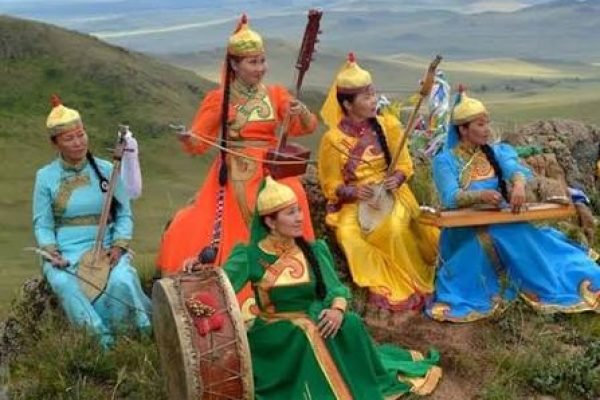
Tuvan Khöömei: History and Techniques
Tuvan Khöömei: History, Philosophy, and Techniques of Traditional Tuvan Throat Singing

Tuvan Khoomei is what has most fascinated me in my studies and research on overtone singing over the past few years, guiding me in the creation of a large part of my Metodo4L. Since 2015, I have been deepening my study of it through listening sessions, meetings, and lessons with Tuvan singers, while also consulting scientific research and books. The most significant moment of this journey came in February 2026, after a meeting with the Alash Ensemble: that experience confirmed that I had correctly understood the technical foundations of Tuvan Khoomei, and I came to understand why those who are not of Tuvan origin often struggle so much while trying to learn this art form.
What Is Tuvan Throat Singing
Tuvan throat singing (called Khoomei), at the heart of Tuvan tradition, is the most emblematic expression of Tuva’s culture. Originating among the nomadic herders of southern Siberia, this vocal style allows the singer to produce two or three distinct sounds simultaneously: a fundamental note with a guttural timbre, melodic harmonic overtones, and, at times, a third subharmonic sound produced by the false vocal cords, or another amplified harmonic made audible by the spontaneous quivering of the lips.
The term khoomei (pronounced ho-méi, Хөөмей in Cyrillic) generally means “throat” in Tuvan, but it refers both to the set of overtone singing techniques and to a specific style. To truly grasp its essence, nothing beats a live concert by legendary groups such as the Alash Ensemble, Chirgilchin, Tyva Kyzy, or Huun Huur Tu—contemporary masters who keep alive a tradition deeply rooted in the daily and spiritual life of the Tuvan people.
The Animist Philosophy of Tuvan Khoömei
Tuvan khöömei transcends mere vocal technique: it is an animist philosophy that celebrates the unity between humankind, nature, and the cosmos. For the Tuvans, “everything around us is music.” The wind among the rocks, the gurgling of streams, the neighing of horses, the calls of animals—every natural element has its own voice.
The singer thus becomes a sonic mediator between the human world and the world of spirits (eezi), who inhabit the mountains, rivers, and taiga. The multifaceted sound reflects this cosmological vision: the fundamental note represents the earth, the body, and the breath; the harmonics evoke the sky, the spirit, and the invisible; and the potential subharmonics call to mind the depths of the mountain, the underground, and the roots.
Singing khoomei is not so much a performance, but rather mainly a musical praise: an offering to the spirits to receive protection during journeys, a blessing for the herds, and harmony in shamanic rituals. It is also a form of personal contemplation, in which the herder, alone with the landscape, attunes himself to the land around him.

Tuva, the Land of the Singing People
Tuva is an autonomous republic of the Russian Federation, covering an area of approximately 170,000 km², located in south-central Siberia, on the border with Mongolia. It is an extreme landscape: more than 80% mountainous, with the Sayan Mountains (which, no, are not related to the anime Dragon Ball, despite the similar name) and the Tannu Ola range, both reaching nearly 4,000 meters; covered in forests of larch, birch, and Siberian pine; and traversed by the great Yenisei River, which originates right in Tuva from the confluence of two headwaters. The capital, Kyzyl, is often cited as one of the most isolated cities in the world, with summers reaching +40°C and winters dropping to 40°C below zero.
The Tuvan people, numbering about 300,000, belong to the Turkic-speaking group: descended from ancient nomadic hunters and herders, they lived for a long time in yurts, moving with their herds of yaks, horses, and sheep. Over the centuries, they were under the influence of Turkic, Mongol, and Manchu empires, until their definitive annexation into the Soviet sphere in 1944.
Today, the Tuvans are partly settled; they work in livestock herding, agriculture, and industry, but they maintain a strong tradition of shamanism alongside Tibetan Buddhism. In this context, Tuvan khoomei represents a sort of sonic backbone of national identity—a distinctive trait that has withstood political and social transformations. The Tuvans sing for nature because they are children of the steppe and the mountains: the shepherd who sings Tuvan khoomei lifts the spirits of those around him and thanks his ancestors for passing down the songs to future generations.
This musical tradition survived even the Soviet era precisely because it is rooted in everyday life: it is sung at banquets, horse races, traditional wrestling tournaments, and evening gatherings. It is not “stage folklore,” but a living part of Tuvan social life and spirituality.
The Three Styles of Tuvan Overtone Singing
Tuvan overtone singing techniques are divided into three main styles, each linked to a specific landscape or natural element: kargyraa is the voice of the mountains and the steppe; sygyt is the whistle of the wind among the rocks and the song of the birds; Tuvan khoomei evokes the murmur of water and the wind during horseback rides.
Khöömei
Khöömei (Хөөмей, pronounced hòo mei) is both the generic term for all techniques and a specific style: the basic timbre is essential for anyone who wishes to practice the other styles in the traditional manner. The true vocal cords vibrate normally, while the false vocal cords create a particular constriction—sometimes called “khorekteer”—that produces the characteristic metallic timbre, making the overtones extremely clear.
The initial challenge is learning to close the false vocal cords without unnecessarily tensing other muscles, allowing the true vocal cords to vibrate freely. Good control of breathing and subglottic pressure is necessary to perform the technique safely, without causing injury.
“No vocal technique is harmful in and of itself, as long as it is performed correctly.”
The most commonly used fundamental frequencies range between G2 and G3 (approximately 100–200 Hz). Melodies are built on a selection of harmonics that form a sort of major pentatonic scale: specifically, harmonics 6, 8, 9, 10, 12, and 13 are emphasized, while the seventh and eleventh are excluded because they would disrupt the solemn and relaxed atmosphere of the major pentatonic scale.
Sygyt
The sygyt (Сыгыт, pronounced s g t) is probably the most instantly recognizable style, because the harmonics emerge as a veritable “flute within the voice.” The tip of the tongue rests against the palate, while the vowels are modulated between U and I, and the singer selects and emphasizes the pentatonic harmonics with extreme precision. Those hearing sygyt for the first time often get the impression that there is a musical instrument, in addition to the human voice.
The fundamental pitches of sygyt are slightly higher than those of khöömei: generally around D3 and E3 for low voices (approximately 145/165 Hz) and G3 for high voices (approximately 196 Hz). The main criterion, however, remains finding a pitch that allows the harmonics to be clearly amplified at least up to the twelfth. In the West, a similar technique—though entirely different in the timbre of the fundamental note—is called “L technique”; however, without constriction of the false vocal cords, it is not correct to refer to it as sygyt.
Here, then, is how overtone singing inspired by the aforementioned Tuvan technique sounds:
The selection of harmonics occurs in exactly the same way as in the Tuvan sygyt, but the fundamental is not produced by the false vocal cords. Another variation involves adding a “twang” to the tone, which is achieved by constricting the aryepiglottic sphincter. Here, too, the false strings do not come into play, but the sound tends to resemble that of the Tuvan sygyt—and… as a result, it’s very easy to get confused! Here’s a comparison of the three tones:
Kargyraa
The kargyraa (Каргыраа, pronounced kar guh ràh) is the “voice of the mountain”: a deep, cavernous tone often compared to a controlled roar. Here, the false vocal cords vibrate in adduction, producing a subharmonic an octave below the fundamental frequency of the true vocal cords, which is perceived as a bass voice harmonizing an octave lower than the singer.
There are two main sub-styles: the Dag Kargyraa (“mountain”), with a neutral, speech-like starting timbre, often sung around C3 (130 Hz) with a sub-octave of C2 (65 Hz), a close relative of the Bassu of Sardinian Tenor Singing, although the latter operates at higher pitches and serves a choral rather than a solo function; the Khovu Kargyraa (“steppe”), sung on slightly higher notes, combines the vibration of the false vocal cords with the timbral constriction of khöömei, resulting in a dry, penetrating sound.
In recent decades, kargyraa has been practiced increasingly by women as well, thanks to musicians such as Choduraa Tumat in Tuva and Zolzaya Damba in Mongolia, as well as vocalists like Jackie Jannsens (Belgium) and Simona Manias (Sardinia).
The Difference Between Khöömei and Kargyraa
The difference between khöömei and kargyraa lies not only in the pitch and timbre of the fundamental note, but also in the laryngeal mechanism itself: in khöömei, the false vocal cords create a constriction that shapes the harmonics, making them clear and producing a whistle-like effect, especially in sygyt; in kargyraa, on the other hand, the false vocal cords vibrate, producing a low sub-harmonic.
Under favorable acoustic conditions, such as in churches and caves, it is possible to clearly distinguish the sub-octave produced by the false vocal cords from the voice of the true vocal cords, and the effect is…stunning.
Substyles and embellishments
In addition to the three main styles, the Tuvan tradition incorporates numerous aesthetic and rhythmic variations. The borbangnadyr is a rhythmic effect achieved through rapid movements of the tongue and/or lips, in order to generate trills and vibratos that evoke the gurgling of streams or the wind among the rocks. The ezengileer, on the other hand, reproduces the rhythm of a horseback ride marked by the metallic clang of stirrups (the name itself derives from “ezengi,” meaning “stirrup”). This effect is achieved by intermittently opening the soft palate, which periodically diverts the airflow into the nasal cavities, producing a very percussive nasal timbre.
The byrlang is a particularly fascinating technique: a semi-voluntary muscular vibrato of the upper lip that emphasizes the second or third harmonic while the fundamental and other harmonics remain stable, giving rise to true three-part singing.
The dumchuktaar (from dumchuk, “nose”) is similar to the sygyt but performed with the mouth completely closed, with air and sound emerging only from the nostrils; this technique was made famous by Kongar-ool Ondar, and is also combined with the kargyraa in the so-called Dumchuk-kargyraa.
Finally, the chylandyk blends kargyraa and sygyt into a sound rich in harmonics, where the sub-octave opens up almost chromatic combinations between distant harmonics, generating a particularly dense soundscape.
Tuvan khoomei today
Thefirst five styles—khöömei, sygyt, kargyraa, borbangnadyr, and ezengileer—are the standardizedforms officially used by the Tuvan National Orchestra and leading ensembles, such as theAlash Ensemble, which you can see in the photo below. Around the world, however, the practice of overtone singing is giving rise to new variations: experimental combinations, applications in contemporary contexts such as jazz, ambient, and meditative music, and adaptations to different musical systems.
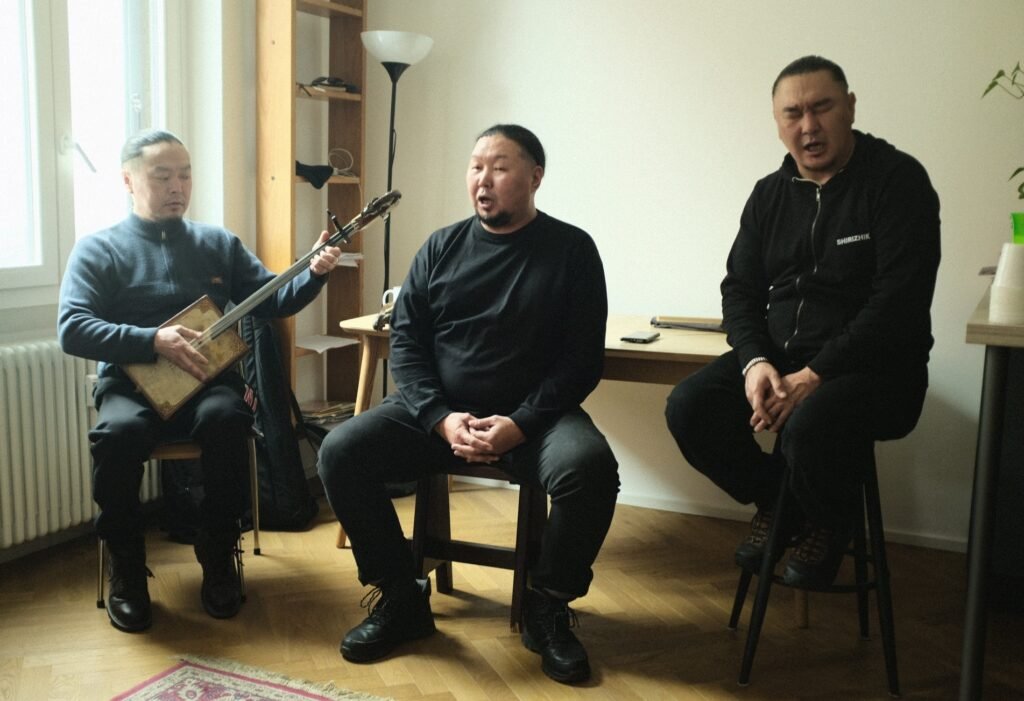
At the same time, these developments are a sign that Tuvan khoomeiis a living and vibrant tradition, capable of preserving its distinctive stylistic elements even outside its native land, while remaining deeply rooted in the original gesture itself: a human being who, standing before his or her landscape, allows the voice of nature to resonate within. As with all traditions, preserving the original form remains essential to ensure it is not forgotten. Today, it can be said that, thanks to the ever-growing number of passionate practitioners around the world, evolution and tradition coexist in a fruitful balance, marked by mutual respect and mutual preservation.
Read also the article: Is AI the Future of Technology?

You may also like

Tuvan Khöömei: History and Techniques