Origins of sardinian throat singing — From Agrarian and Pastoral Life, to the Spotlight
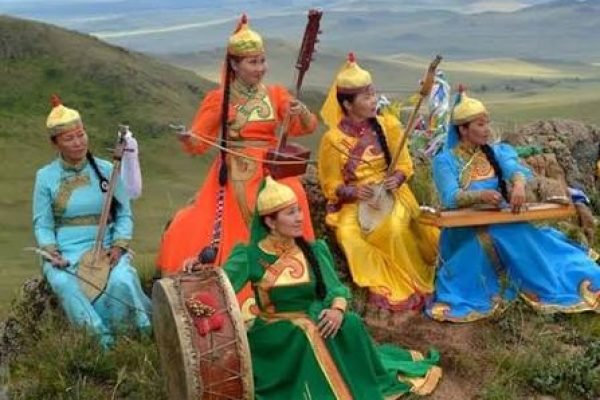
If you want to hear singers who masterfully use guttural vocals, there’s certainly no shortage of opportunities these days, given the many Tuvan and Mongolian groups touring the world. Let’s keep in mind, however, that in Sardinia (an island geopolitically connected to Italy), guttural singing is a living tradition, rigorously passed down from generation to generation within the traditional context of Canto a Tenore.
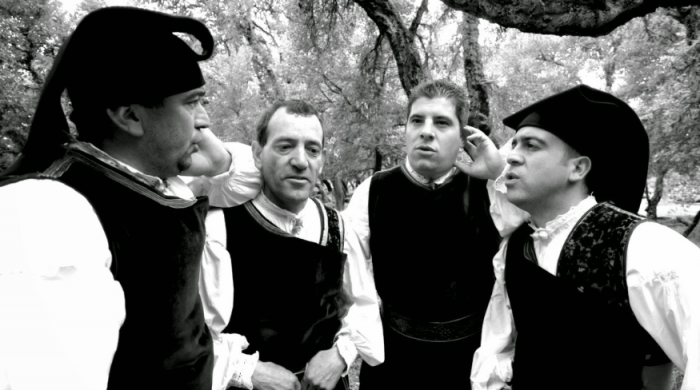
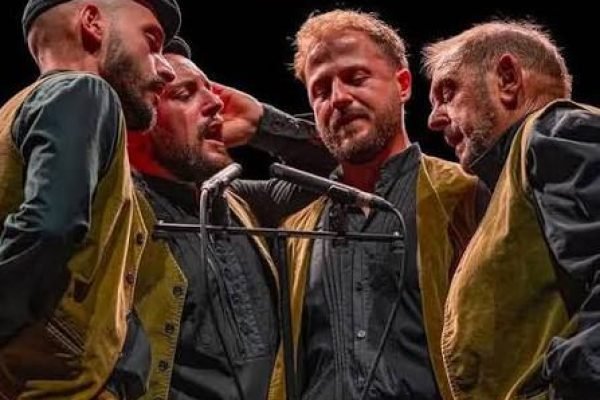
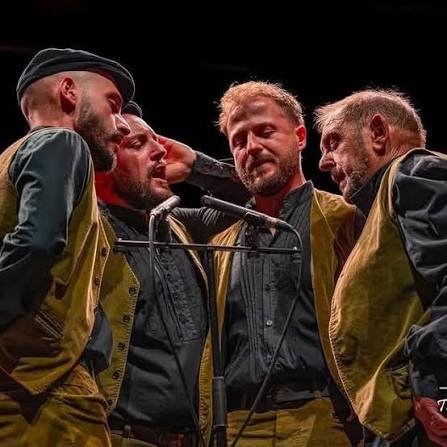
Canto a Tenore is a poetic and musical tradition rooted in central and northern Sardinia. It is a polyphonic form consisting of four voices: bassu, contra, boghe, and mesu boghe. The distinctive feature of “tenore” is the presence of the two guttural voices, bassu and contra, which are pitched a fifth apart: it is precisely this combination that gives the singing its unique and unmistakable character. The boghe acts as the soloist and begins the piece; the other three parts follow in harmony, supporting it with guttural timbres. Except in certain specific repertoires, in almost all cases only the boghe articulates the lyrics, while the other singers emit meaningless syllables, transforming the voice into a sort of musical instrument and creating a tapestry of notes and timbres.
The term “tenore”—or, depending on local variations, “cuncordu,” “cussertu,” “cuntratu,” or “cunsonu”—refers to the entire quartet; however, the same word can also refer solely to the accompanying trio of singers with guttural voices. Thus, the Sardinian term does not correspond to its Italian counterpart, where “tenore” refers to a single singer in a specific vocal range: in Sardinian, however, it is a collective term that identifies the group of singers and could be more appropriately rendered as “choir,” since it is, in fact, a very distinctive form of choral singing.
The reasons that led UNESCOto include Canto a Tenore on the prestigious list are not solely musical in nature.
As stated in the official rationale, in addition to representing the primary form of musical expression in the pastoral culture of central Sardinia, Tenor Singing is also considered fundamental because it constitutes a practice that defines identity—through which a community has been able to preserve and pass on to subsequent generations a musical heritage of extraordinary richness. For this reason, simply explaining in words what Tenor Singing is… isn’t enough; rather, it should be experienced and heard. With this article, however, I will do my best to share with you what I have learned over the years by speaking with various Tenores, including the Tenores Santa Sarbana of Silanus, the Tenores of Neoneli, the Tenores Su Remediu, and the Tenores Antoni Milia of Orosei.
ORIGINS OF CANTO A TENORE
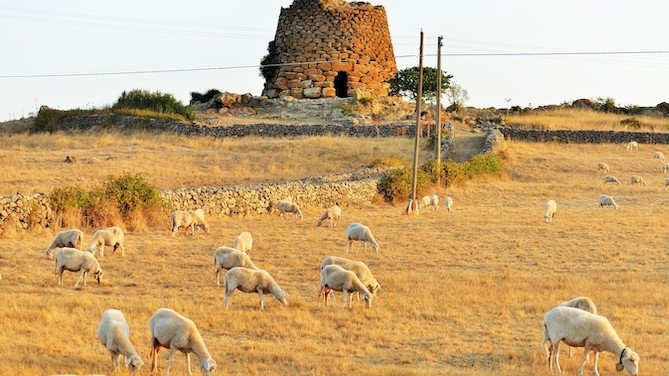
Let’s begin by understanding where and how Tenore Singing originated. First of all, traditional life in central and northern Sardinia was marked by a very clear division of labor: the men—who were shepherds—spent long periods away from the village, sleeping in sheepfolds, immersed in the silence of the countryside. From time to time, they would gather in small groups and, in that silence, sing. The women, on the other hand, remained in the village and cultivated other art forms—including vocal ones—specific to their own context.
Every Canto a Tenore group is different from the others, distinguished by its own unique stylistic traits: each village has brought its own mindset, its own rules, and its own character to the singing.
Canto a Tenore TODAY
If Tenore singing has remained a predominantly male practice for centuries, it is not due to deliberate exclusion, but because it arose from a way of life—that of the isolated shepherd—which was historically predominantly male. There were no taboos or prohibitions, as is sometimes mistakenly perceived from the outside, but rather an almost clear-cut division of roles resulting from a natural reflection of lives that unfolded in different spaces and times. Sardinia has changed since then. Men and women now share spaces that were once separate—and with them, the sounds as well. Women, too—increasingly exposed to Tenore singing in their daily lives—not only on formal occasions but also in informal and performative contexts—have naturally developed a desire to try their hand at it. It is a direct consequence of greater proximity: continuously listening to a musical practice generates curiosity, attraction, and, ultimately, the desire to actively participate in it.
And so it is that Canto a Tenore is increasingly viewed today in a context that is less rural and more performance-oriented and academic: it is studied, analyzed, and brought to the spotlight.
This is a valuable development that allows for a deeper exploration of vocal technique, harmony, acoustics, repertoires, and ensembles. But just as scientific and artistic interest grows, it becomes essential not to lose sight of the human context in which this music was born: the deeply personal need to carve out a space for oneself, for poetry, and for sound—amidst hours of solitary work and being far from home—and especially when one feels the need for it, free from the typical responsibilities dictated by the profession of a musician.
There is a profound analogy here with the singing of the Tuvans, who are also globetrotting musicians today but who were originally herders who spent long periods in the steppe or in the mountains—periods that led them to develop a form of vocal art aimed at touching the depths of nature through the exploration of sound. When an elderly Tuvan is asked to explain the ancient art of khöömei singing, the answer is always the same: “Go out alone into the middle of the steppe, or to the top of a mountain. Look at the landscape around you and start singing. That is what khöömei is.”
Remembering this does not mean idealizing the past, but rather honoring the original impulse that gave rise to this music: the universal human need to find inner silence in order to listen to the world around us.
Composition of the quartet
As previously mentioned, the choir consists of four parts—or, more precisely, the combination of the solo voice, “sa oghe,” and “su tenore,” which in turn is made up of three entirely distinct voices: the “bassu,” “sa contra” (short for “contrappunto”—the bass part),
and “mesu oghe” (the middle voice). Here are two diagrams showing the placement of the voices on the piano in the two chords most commonly used in the tradition: G major (above) and F major (below).
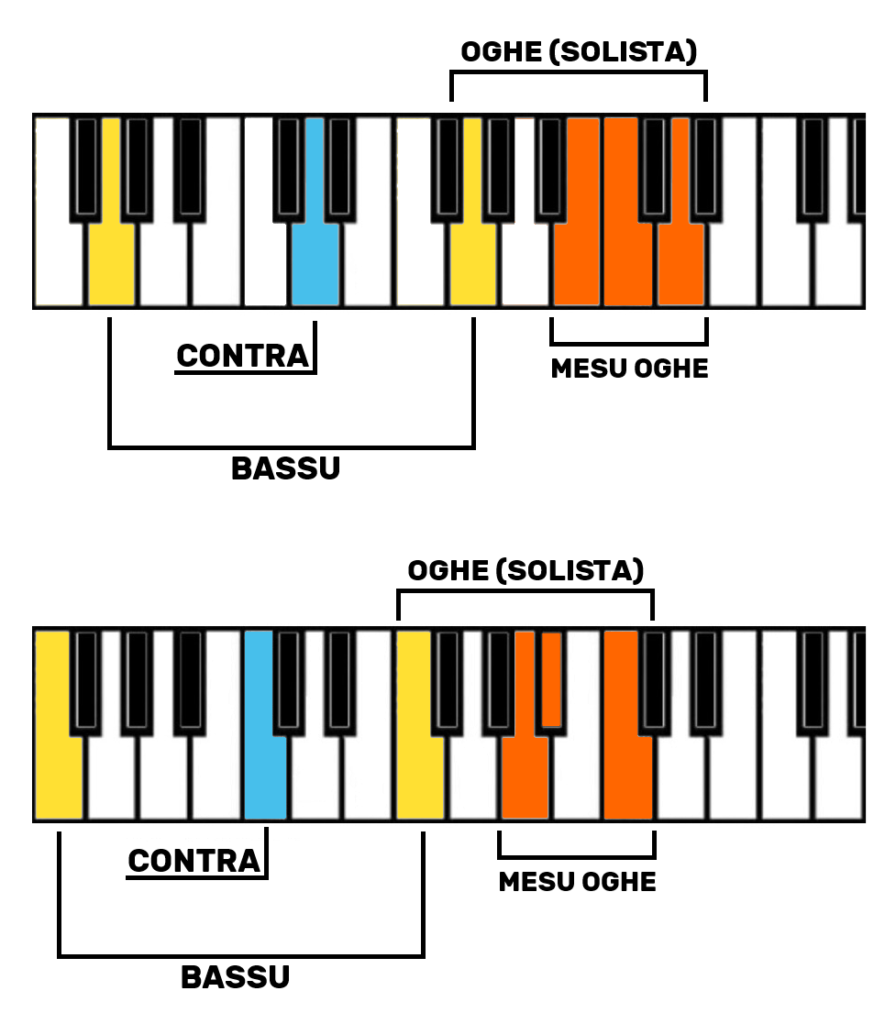
The soloist, known as “sa oghe,” is positioned in pitch right in the middle of the tenor voices, in a range between that of “sa mesu oghe” and those of “su bassu” and “sa contra.” In addition to singing the poetic lyrics, his role is to set the rhythm and tempo of the pieces for the other choristers.
Sa mesu oghe is responsible for harmonizing with melodic embellishments, in a register slightly higher than that of the soloist. It often sings melodies when the soloist is not singing. According to legend, the melodies of sa mesu oghe evoke the sound of bells.
The “bassu”, as the name suggests, is the lowest voice, but we’ll see shortly that this isn’t exactly the case. It is responsible for anchoring the key of the piece. According to some legends, it imitates the bellowing of cattle. This particular timbre is achieved through a technique called “falsocordale,” since it uses both the false vocal cords and the true vocal cords simultaneously (exactly as in the Kargyraa Tuvan). When heard on its own, it is perceived as a very low voice, but upon a second listen, one can notice that there are actually two voices, both coming from the same person: one of medium pitch and one exactly one octave lower. The false vocal cords are responsible for the octave drop, achieved through an acoustic phenomenon known as false vocal cord consonance, which activates a subharmonic: for this reason, the sound of the bassu is lower than that of Sa Contra, but the truth is that Sa Contra is technically the lower voice, from the perspective of vocal range.
Since the bassu part does not require (despite the name) a particularly low range, it can also be performed by female voices, although it should be noted that female voices, on average, have a higher range than male voices.
The voice of Sa Contra—probably an abbreviation of “contrapunto” or “controvoce”—is, according to legend, an imitation of the sound of a goat and is pitched a fifth above Su Bassu. From the perfect fusion of Bassu and Contra arises the harmonic foundation upon which the other two voices rest. Sa Contra employs a vocal technique that enriches the timbre with strong, metallic, and resonant overtones. This timbre is also found in Central Asia, among the Tuvan throat singing techniques—where it is called khöömei—and, to some extent, in South Africa, in the songs umngqokolo of xhosa women.
Given the obvious similarities with these forms of diphonic and guttural singing, Tenore singing is considered the only ancient form of guttural singing (commonly called “throat singing”) to have developed in Europe, due to the characteristic guttural timbre of the Bassu and Contra registers. In this case as well, the technique can be learned by both men and women. The difficulty is sometimes related to the register, because the required pitches are generally lower than those of the Bassu and emphasize a guttural timbre that, statistically speaking, female voices find a bit more difficult to produce naturally. Nevertheless, there are excellent examples of female Contra singers, including Jackie Jannsens (Belgium), Alicja Piotrowska (Poland), and Fumiko Wada (Japan).
INCLUSION OF FEMALE VOICES
Throughout the history of Canto a Tenore, there have never been any real taboos regarding the participation of women in Canto a Tenore choirs; on the contrary, over the years there have been several instances where men themselves have shown a willingness to include female voices: the first documented evidence comes from footage from 1994 showing Giovanna Pira (Tzia Juanna de Pascalone) singing the part of “sa oghe” in Bitti. Other accounts dating back to before the 1990s refer to performances by women singing in the tenor voice, mostly in informal settings.
The first choir to experiment with female guttural vocals dates back to the late 1990s in Bitti and was formed as part of a “Canto a Tenore” course funded by the Region of Sardinia, in which six young women participated, including Pierangela Calzone. The experience is documented in the archives of the ISRE (Regional Higher Institute of Ethnography) and at the Sassari Conservatory. To be fair, during that course, it was not possible to form an all-female Tenore choir, since only one singer (Adriana Fancello) proved capable of performing the guttural techniques of bassu and contra; therefore, to complete the guttural harmony, it was necessary to include an additional male voice.
During those same years, the Belgian musician Jackie Jannsens took on the roles of bassu and contra alongside the musician and ethnomusicologist Raphael De Cock, after the latter visited Sardinia and befriended Pierangela Calzone and Omar Bandinu, co-founder of Tenore Mialinu Pira.
It is important to mention the singer Cristina Lanzi, who also developed the bassu technique and incorporated it into her music. Her career spans women’s choral singing, jazz, singer-songwriter music, and the Sardinian-language repertoire. She was a member of the original lineup of Le Balentes, a female vocal group from Cagliari founded in 1990, and has performed as a backup singer in various singer-songwriter and Mediterranean music projects. She has also sung with the vocal ensemble Andhira and with the Cagliari Jazz Orchestra, including during a tribute to Frank Sinatra. Here we can listen to her song “Zorra,” in which she performs the bassu technique with the characteristic rhythm of traditional tenor singing.
More recently, Simona Manias—a singing enthusiast since the days of Area and Demetrio Stratos—learned the bassu technique in 2017 in one of my classes, and nearly 10 years later, she was invited by the Orosei Tenor “Antoni Milia,” with whom she experimented with mixed-voice singing—as Jackie Jannsens had done years earlier—taking on the role of the “female” bassu alongside male Contra and Mesu Oghe singers, creating the typical guttural harmony.
As the Tuvan masterOorzhak Kunashtaat-Oolsaid at the time when it was decided to put an end to the taboo against Tuvan women practicing khöömei:
“We also have women who perform khöömei. If people ask me what I think about it, I say that I think it’s a good thing and that I support them. There’s nothing wrong with this, because this voice comes from nature and from a mother. Personally, I also give them advice. The girls’ voices are special, beautiful, and unique in their own way.”
The voice should know no genre boundaries: everyone can explore and sing any style, from opera to gospel, from jazz to rock and metal, all the way to traditional throat singing. There are no limits, only expressive possibilities; and this is precisely why tradition is so invaluable—because it preserves and passes down what, before the Internet, developed spontaneously over time, often within small communities, in a direct and profound relationship with nature.
Preservation of ‘Canto a Tenore’
One of the key institutional centers for the preservation and exhibition of this vocal tradition is the Multimedia Museum of Tenore Singing, located in Bitti, in the province of Nuoro, within the Museum of Pastoral and Peasant Culture. Opened in 2005—the same year that UNESCO proclaimed Tenor Singing a “Masterpiece of the Oral and Intangible Heritage”—the museum serves as an interactive research center on Sardinian polyphony.
The exhibition is organized into several interactive rooms designed to provide a multisensory experience:
– Tenor Singing Audiovisual Room: This room features four large vertical screens that replicate the circular arrangement of the four singers (oche, mesu oche, contra, and bassu), allowing visitors to mute and unmute the audio for individual voices so they can hear the different vocal timbres and corresponding vocal parts.
– Sound and Multimedia Archive: This archive contains recordings of the island’s most important historical groups.
– Ballroom: an interactive space where visitors can learn the steps of traditional dance, which is inseparable from the performance context of the tenore.
– Rooms displaying antique furniture and tools of the trade, such as looms, tools for making bread and cheese, containers for storing food, and clothing to protect shepherds from the cold and inclement weather.
Tenore Singing and Musical Fusions: Jazz, Innovation, and Musical Collaborations
• Tenores di Bitti “Remunnu ‘e Locu” and Peter Gabriel (1974, 1996)
The Tenores di Bitti “Remunnu ‘e Locu” collaborated with Peter Gabriel, who produced their 1996 album *S’Amore ‘e Mama*, released by Real World Records. The group also occasionally collaborated with Frank Zappa, who produced one of their CDs. Other collaborations include those with American jazz musicians Ornette Coleman and Lester Bowie. In 2007, they were awarded the title of Knights of Merit of the Italian Republic.
• Elio and the Tenores di Neoneli (1990s)
Elio (Stefano Belisari) of Elio e le Storie Tese has been collaborating with the Tenores di Neoneli since the early 1990s; their collaboration gave rise to the NeonElio project, which took shape in 1996. In 1990, Elio sang in the Sardinian language with the group Zenias. Among the best-known moments of this collaboration is the adaptation of “Terra dei cachi” into the Sardinian language with the Tenores di Neoneli.
• Paolo Fresu and Cuncordu e Tenore de Orosei (2011)
Paolo Fresu, a trumpeter born in Berchidda in 1961, participates in projects featuring traditional Sardinian music. On the album *50 – Cinquant’anni suonati* (2011), he collaborated with Cuncordu e Tenore de Orosei, the Castelsardo Choir, and Su Cuncordu e Su Rosariu from Santulussurgiu on the track “Miserere.”
• Gavino Murgia (2000s–2010s)
Gavino Murgia (Nuoro, 1969) is a Sardinian multi-instrumentalist and saxophonist who sings with the Tenore Gòine of Nuoro using a guttural vocal style known as su bassu. This vocal style is a central component of his musical language: Murgia uses it not only in the context of traditional singing but also in improvisations and various solo works, employing a wider range of notes than is typical of traditional Canto a Tenore. In this regard, he has a distinctive style; one need only listen to “Megalitico“from 2009 (traceable to the Tuvan style Igor Koshkendey and Vladimir Oidupaa and their albums from the late 90s. milestones.).
After attending Paolo Fresu’s seminars in Nuoro, he continued his studies in Siena and became the lead tenor saxophonist of the Italian Youth Jazz Orchestra. Throughout his career, he has collaborated with numerous musicians, including Rabih Abou-Khalil, Bobby McFerrin, Michel Godard, Gianluigi Trovesi, Antonello Salis, Mal Waldron, Djivan Gasparian, Paolo Fresu, Roswell Rudd, Hamid Drake, Al Di Meola, Mauro Pagani, Vinicio Capossela e Gianna Nannini.
• Tenores di Orosei “Antoni Milia” and Moses Concas (2010–2020)
The “Antoni Milia” Tenores of Orosei, active since 1975, have recently collaborated with Moses Concas, a Sardinian harmonica player who combines the harmonica and beatboxing in his musical work. This collaboration is documented in events held in Orosei in 2026, including a music workshop with Moses Concas dedicated to the Respiro Sonoro project.
Alongside this, there is also a collaboration with Zoe Pia, a Sardinian clarinetist, who has shared performances and projects with the Tenores di Orosei Antoni Milia. In this case, the dialogue takes place between the timbre of the clarinet and the four tenor voices, forming part of a journey that connects the traditional repertoire with different instruments and musical contexts.
• Enzo Favata and the Tenores di Bitti (2017–2024)
Enzo Favata, a jazz pianist, collaborates with the Tenores di Bitti on the “Polyphony of Stones” project, a concert featuring jazz and tenor singing. In 2017, the Tenores di Bitti performed at Nuoro Jazz with Mialinu Pira. He has collaborated with the Tenores di Bitti in ensembles combining jazz and traditional music.
• Antonio Sorgentone and Tenore Su Remediu from Orosei (2019)
Antonio Sorgentone, the pianist who won *Italia’s Got Talent* in 2019, has collaborated with the Tenore Su Remediu from Orosei. On the talent show, he performs rock ‘n’ roll and boogie-woogie in the style of Jerry Lee Lewis, incorporating falsetto vocals. In the music video for “Bom Bom No. 3,” the tenores perform one of their own songs as an introduction. They performed together at Valledoria Rock’n’Beer in 2019.
CONCLUSIONS
These influences demonstrate that “Canto a Tenore” is a living art form, capable of evolving while keeping its millennia-old essence intact. The Sardinian people cherish a cultural wealth made up of voices, landscapes, memories, and local differences that intertwine without losing their identities. Tenor singing is one of its highest expressions: born of a rural and pastoral way of life, it continues to thrive thanks to those who sing it, those who study it, and those who pass down its history with respect and passion. Its deepest beauty lies in this balance between living tradition and the memory of its origins, for every choir, every village, and every voice helps keep alive an ancient, shared heritage that remains fully vibrant today. It is a world one must enter on tiptoe if one truly wishes to help preserve and honor the cultural value of what is far more than just a form of four-part polyphonic choral singing.

You may also like
Tuvan Khöömei: History and Techniques