Polyrhythm and polyphony: Are they the same phenomenon?
Polyrhythm and polyphony are not exactly the same phenomenon: the former involves the overlapping of different rhythms, while the latter involves the simultaneous presence of multiple independent melodic lines. They are, however, closely related, because both arise from the organized overlapping of sound events over time.
What Is Polyrhythm
A polyrhythm is, simply put, the overlapping of two or more different rhythms performed within the same time frame. Imagine two people playing together within the same measure: the first claps three times at regular intervals, while the second, at the same time, claps four times, also at regular intervals. The two rhythms intersect, become out of sync, create contrasting accents, and coincide again only at the beginning of the next cycle.

Of course, a polyrhythm can also be performed by a single person, even with the voice. For this very reason, short phrases are often used in teaching to help students internalize certain rhythmic subdivisions. For example:
- 2:3 → “Nice Cup Of Tea”
- 3:4 → “Pass The Peanut Butter”
- 4:5 → “I’m Looking For A Home To Buy”
Beyond these practical examples, polyrhythm is by no means a modern curiosity, nor is it merely a mathematical game. It is one of the fundamental principles of many musical traditions around the world. In much of the music of sub-Saharan Africa, for example, different instruments play distinct rhythmic patterns that, when layered, give rise to a complex and coherent rhythmic texture. The same is true, in different forms, for the music of South India, for much Afro-Cuban music, and for various traditions in which musical time is not experienced as a uniform and rigid beat, but as an interweaving of different pulses.
Polyrhythms in Western Music
Even in the history of European music, we find examples of the overlapping of different rhythmic proportions. In some repertoires, the voices could proceed at different tempos, producing an effect that we would readily describe today as polyrhythmic. In other words, the idea of combining multiple tempos within the same temporal space is ancient, widespread, and deeply rooted in human musical experience.
Here are a few examples worth mentioning:
•Josquin Desprez—Agnus Dei II from the *Missa L’homme armé super voces musicales*: This is perhaps one of the absolute masterpieces of Renaissance rhythmic complexity. Composed of a series of mensural canons, in this work different voices sing the same melody but interpret it with different tempos or rhythmic patterns (known as “prolations”), creating a complex polyrhythmic and polymetric texture.
•William Byrd – “Browning (The Leaves be Green)”: A composition for viols in which the main theme passes through various parts, creating rhythmic swirls that lead to the layering and intensification typical of English music from the late 1500s.
•La tecnica della “Proporzione sesquialtera“: Non si tratta di una singola composizione, ma di una pratica standard della polifonia fiamminga (come in Obrecht o Dufay), dove una voce esegue tre note nel tempo in cui un’altra voce ne esegue due, creando il classico poliritmo 3 contro 2 all’interno del tessuto sacro.
L’esperimento di Adam Neely
Negli ultimi anni il musicista e divulgatore Adam Neely ha contribuito molto a rendere accessibile questo argomento, mostrando in modo chiaro come i poliritmi possano essere compresi non solo con il conteggio, ma soprattutto con l’ascolto e con l’esperienza diretta.
Among his tips and explanations on how to become familiar with polyrhythms—even the most complex ones, such as 7/11—there is also a fascinating demonstration that shows how a rhythmic relationship, if accelerated enough, can become a relationship between pitch heights perceived as a chord on the piano, proving that polyrhythm and polyphony are closer than one might imagine.
The point is both simple and extraordinary: rhythm and pitch are not two separate worlds, since both can be measured as frequencies.
When a sound event repeats slowly, we perceive it as rhythm; when it repeats very quickly, we perceive it as pitched sound.
The difference, therefore, lies not in the nature of the phenomenon, but in the speed at which it occurs.
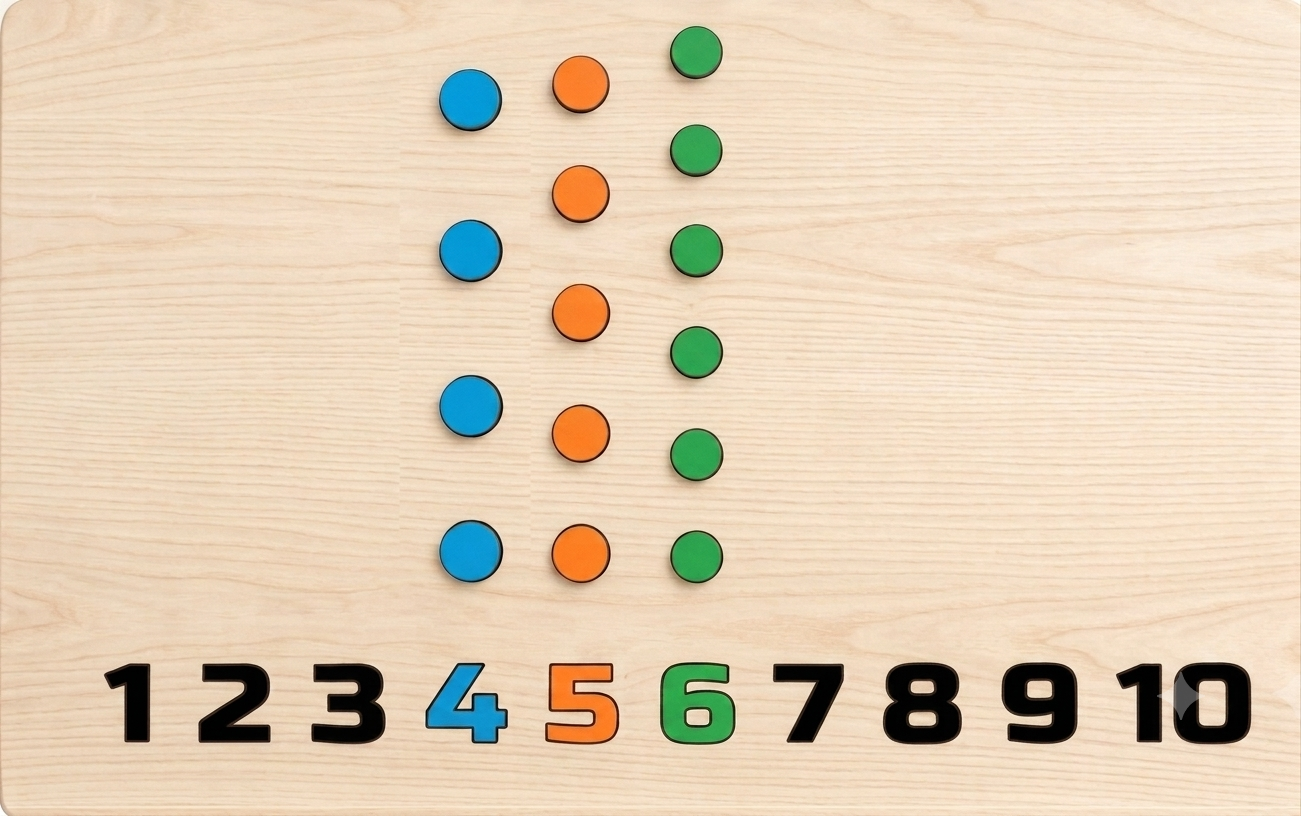
Neely demonstrates exactly this: a polyrhythm such as 4:5:6, when progressively accelerated, ceases to be perceived as a sequence of separate beats and begins to be heard as a musical chord.
In that specific case, the 4:5 ratio corresponds to a pure major third, while the 4:6 ratio is in fact a perfect fifth.
The transition from rhythm to harmony is therefore not a poetic metaphor: it is a perceptual shift in the same physical ratio.
Polyrhythm and polyphony become distinguishable solely based on the tempo!
This idea, which is surprising in and of itself, becomes even more fascinating when we move on to ratios like 4:5:6—that is, three different subdivisions occurring simultaneously. Here, we no longer have just an interval, but something that can turn into a full-fledged chord. Here’s a video I made, inspired by Adam Neely’s TED Talk:
Polyrhythm and Polyphony: What’s the Similarity?
If you think about it, rhythm and pitch can both be described in terms of frequency. The speed of a rhythm is expressed, for convenience, in beats per minute, but it can be converted to hertz—that is, cycles per second. If a piece is in 120 beats per minute, it means the beat occurs 120 times in 60 seconds: therefore, twice per second, or 2 Hz—twice the speed of the second hand on a clock!
Since musical sound travels much faster, it is measured directly in hertz. A note is nothing more than a periodic vibration fast enough to be perceived by our ear as a specific pitch. If the repetition is slow, we hear a series of beats; if it is fast enough, we hear a note. The underlying physical principle, however, remains the same.
Let’s now consider the 4:5:6 polyrhythm. This means that, within the same unit of time, 4, 5, and 6 regular pulses are distributed. If we gradually accelerate this ratio, we reach a point where the pulses are no longer perceived as separate events, but as sound frequencies. And since the numerical ratio remains the same, the ratio between the resulting pitches will also be 4:5:6.
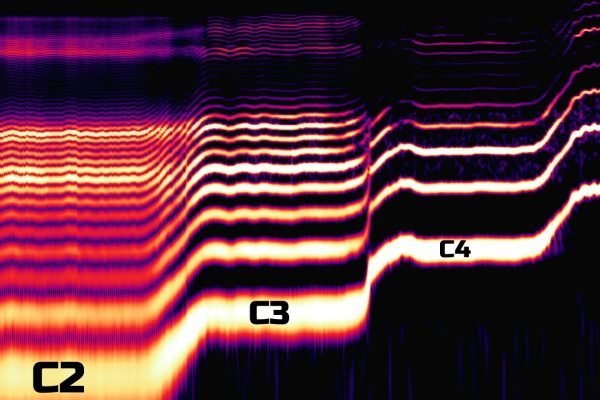
This is where the harmonic series comes into play: it already contains the 4th, 5th, and 6th harmonics, whose ratio generates exactly the three sounds that make up a major triad—the root, the major (perfect) third, and the perfect fifth. In other words, if we speed up a 4:5:6 polyrhythm enough, our ear no longer hears three overlapping rhythms, but a major chord.
As already mentioned, this is a truly enlightening insight, because it concretely demonstrates that what we call “harmony” and what we call “rhythm” can be two manifestations of the same structure. If we slow down that ratio again, the chord “opens up” over time and is once again perceived as polyrhythm. If we speed it up, the polyrhythm “condenses” and becomes harmony. I recommend listening to the video suggested earlier once more, with this new understanding!
The Natural Major Triad
It’s worth pausing for a moment to consider the tonal quality of the triad that emerges from the 4:5:6 ratio. This isn’t just any major triad, but a pure major triad, based on the natural ratios of the harmonic series. In particular, the resulting major third corresponds to the 5:4 ratio—that is, the pure major third.
This detail is important because, in modern Western music, we are primarily accustomed to equal temperament. In this system, the intervals are slightly adjusted to make it possible to transition from one key to another without having to retune the instrument. The major third in equal temperament, however, does not exactly match the pure major third: it is slightly wider—and this alone may be enough to show just how pointless the debates over 440 or 432 hertz are 😉 .
For those with a trained ear, the difference will be immediately apparent. The pure major third has a distinctive stability and clarity—almost a sensation of the sound being “in focus.” It is one of those cases in which the mathematics of the ratios translates directly into perceptual quality. Let’s look at the figure below, which visually illustrates polyrhythm and polyphony.
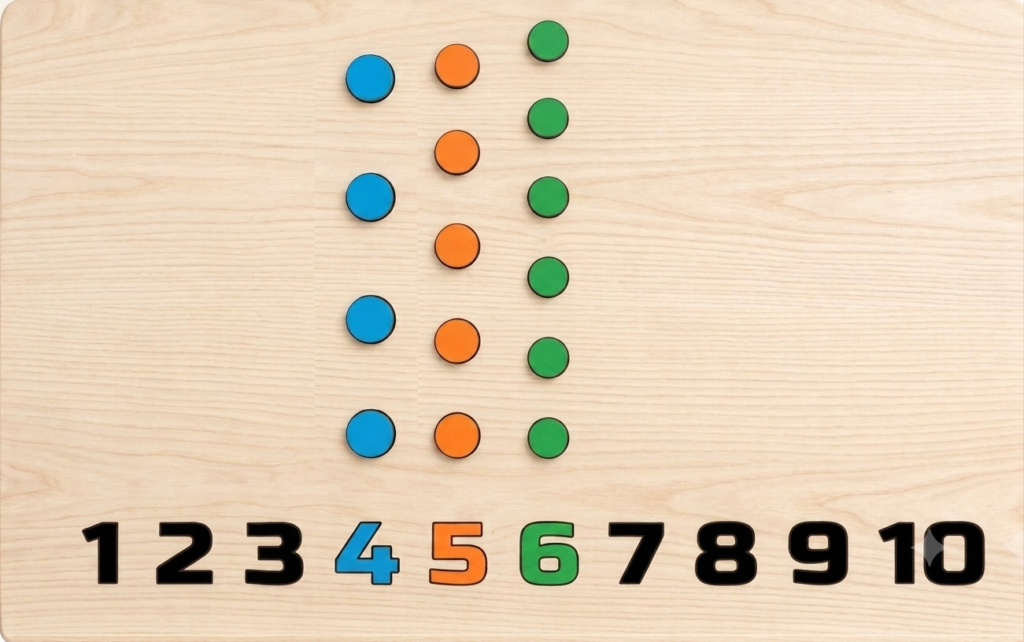
This also explains why the 4:5:6 ratio is so compelling from a sonic perspective. It is not merely an elegant numerical abstraction: it is an arrangement of sounds that our ears recognize as particularly coherent and harmonious.
The pure fifth is also different from the tempered fifth, but the difference is only two cents, and according to recent research, the human ear can perceive, on average, only variations greater than five cents.
The Minor Triad and Subharmonics
If the natural harmonic series leads us to the major triad, it’s natural to wonder if there’s a counterpart capable of explaining the minor triad with the same clarity. Here we enter the realm of subharmonics, a fascinating topic but one that should be approached with a bit of caution.

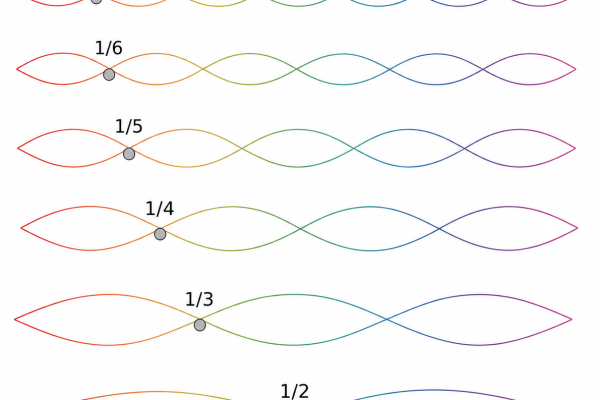
The harmonic series arises spontaneously in complex sounds: every periodic sound carries with it, in addition to the fundamental, a series of higher harmonics. The subharmonic series, on the other hand, does not occur in the same way as a natural, ordinary component of every sound. Rather, it is a theoretical construct obtained by considering the inverse ratios: 1/2, 1/3, 1/4, 1/5, 1/6, and so on.
Proprio da qui nasce l’idea che i rapporti 1/6, 1/5 e 1/4 possano essere messi in relazione con una triade minore. In forma speculare rispetto alla triade maggiore ricavata dagli armonici 4, 5 e 6, questi rapporti consentono infatti di leggere una struttura affine a una fondamentale, una terza minore e una quinta giusta.
From a theoretical standpoint, this symmetry has fascinated many scholars because it seems to suggest a deep connection between major and minor. However, we must be precise: while the major triad can be directly and very concretely traced back to the harmonic series, the minor triad does not emerge in the same way as a common and spontaneously immediate acoustic fact; nevertheless, it is a 100% real physical-acoustic phenomenon.
Subharmonics in Nature
However, just because subharmonics do not normally occur in the same way as harmonics does not mean that real subharmonic phenomena do not exist. In certain nonlinear physical systems, responses can appear at frequencies that are submultiples of the initial frequency. In other words, a system can react not only by “following” the frequency that excites it, but also by organizing itself around a lower frequency that is in a simple ratio to it. The most common example is the human voice! Singing techniques such as Kargyraa and the Sardinian Bassu exploit the phenomenon of the subharmonic series to produce a sub-octave (1/2 subharmonic) using the false vocal cords. Although less frequently, the same subharmonic effect can be achieved using the Vocal Fry technique. Some experimenters have even ventured into lower subharmonics, reaching as far as the 1/5 subharmonic.
A striking example—one that is also useful from an educational standpoint—is that of a tuning fork and a sheet of paper. If a light sheet of paper comes into contact with a vibrating tuning fork, the paper will attempt to vibrate at the same frequency as the tuning fork; when it fails to do so, it will drift toward the subharmonics, since it will “fail” to vibrate 440 times per second, instead vibrating once every two, three, four, or five times… thereby creating the corresponding subharmonics.
If the system is then modified—for example, by altering the mass or the conditions of the vibration—more complex behaviors can be observed, in which the response no longer corresponds linearly to the initial excitation.
From the Sine Wave to the Sawtooth Wave
When discussing harmonics and subharmonics, we cannot fail to mention timbre. In the physics of sound, waveforms describe how sound varies over time. The sine wave is the simplest possible waveform: a perfectly regular vibration consisting of a single frequency. For this reason, it is often considered the purest sound.
All’ascolto, una sinusoide ha qualcosa di essenziale, quasi astratto. Non possiede la ricchezza di un suono strumentale reale, perché manca di quelle componenti armoniche che rendono riconoscibile una voce, un violino, un clarinetto o un sintetizzatore. Difatti, una sinusoide è di fatto un suono del quale si percepisce solamente la frequenza fondamentale senza armonici né subarmonici.
The sawtooth wave, on the other hand, is rich—very rich—in harmonics. It is precisely this abundance of components that gives it a bright, full, and incisive sound. When we listen to a sawtooth wave, we are hearing many frequencies coexisting at the same moment, fused into a single timbral perception.
And this is where the argument comes full circle. If we were to listen to those frequencies one by one, they would be perceived as distinct notes. If, on the other hand, they all sound together, our ear unifies them into a single timbre. Once again, what changes is not the nature of the phenomenon, but the way it is organized and perceived.
Subtractive synthesis makes this principle very clear. You start with a rich sound, full of harmonics, and gradually filter it, eliminating certain frequency components. As the harmonics are attenuated or removed, the sound changes in character, becoming thinner and simpler, until it approaches an almost sinusoidal form. Conversely, additive synthesis builds complex sounds by combining simple frequencies. In both cases, the message is the same: timbre is the result of a multitude of components coexisting simultaneously.
One Principle, Two Manifestations
We started with a simple example of hands clapping in a 3-on-4 rhythm, and we’ve arrived at the very heart of musical acoustics. The transition may seem bold, but in reality it is entirely consistent: rhythm, melody, harmony, and timbre are not separate worlds, but rather different aspects of the same vibrational reality.
A polyrhythm such as 4:5:6, when sped up, becomes a major triad. A major triad, when slowed down enough, can be reinterpreted as a polyrhythm.
Furthermore, the harmonics that make up a timbre can be heard as separate pitches or as a single complex sound. And subharmonics, while more problematic from a theoretical and physical standpoint, open up a valuable space for reflection on the relationship between major and minor, between mathematical symmetry and musical perception.
After all, this is precisely what makes it so fascinating: many of the categories we’re accustomed to using to think about music—rhythm, chord, note, timbre—are not watertight compartments, but rather different ways of describing phenomena that are intimately connected. The time scale changes, and so does the way our ear organizes the experience, but the physical substance remains surprisingly unified.

For this reason, it can be said—without stretching the point too far—that polyrhythm and polyphony are therefore two sides of the same coin.
The only thing that changes is the speed at which it presents itself to our senses.
I hope these reflections have helped you see more clearly how the harmonic series, in its archetypal nature, is truly and fascinatingly present in everything related to sound—especially in music—on the melodic, harmonic, and even rhythmic levels. Enjoy listening and exploring!

You may also like